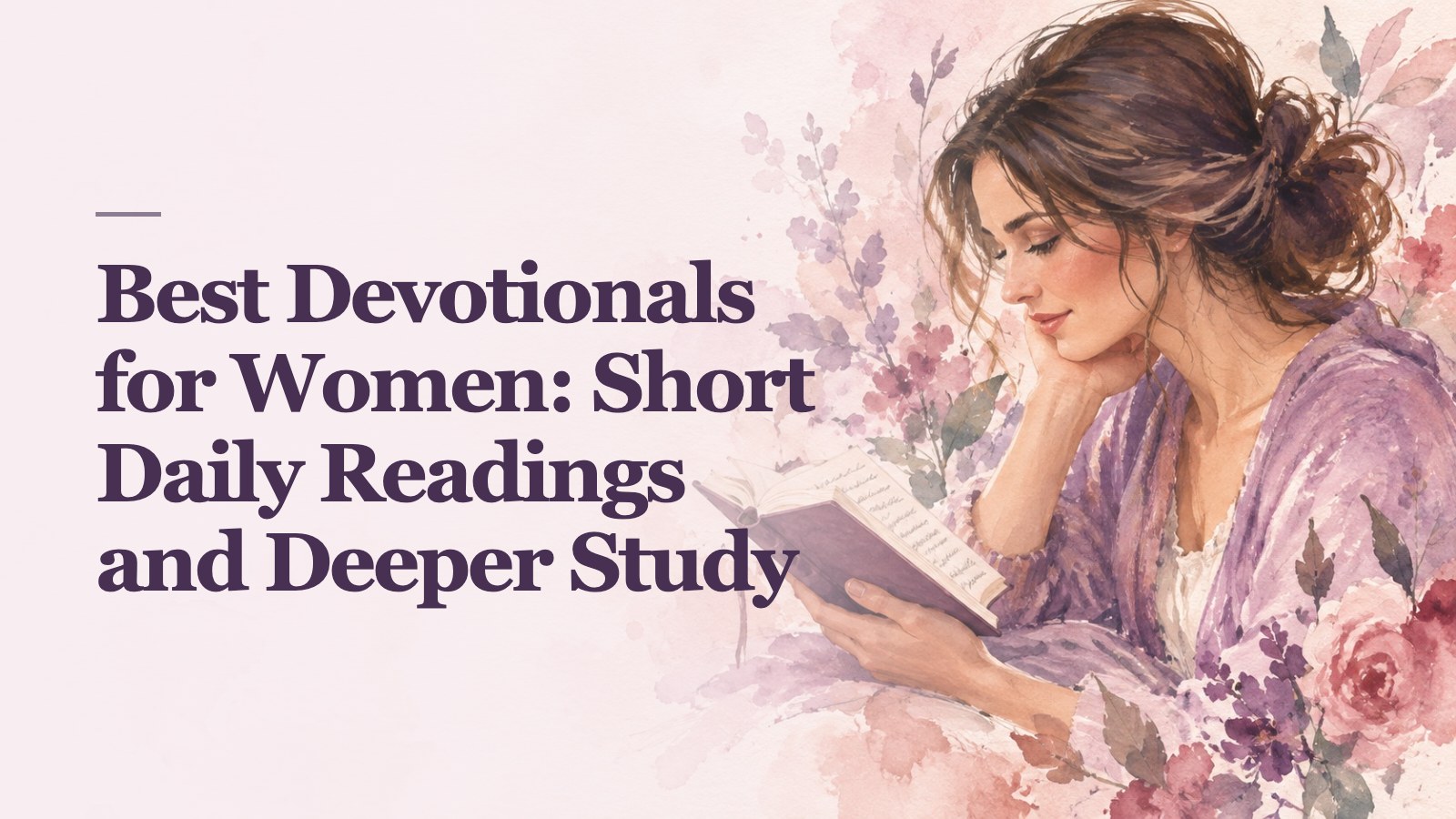
For short daily encouragement, I would start with God Hears Her. For a more focused look at biblical women, consider Women of the Bible. For a shorter themed commitment, compare You Got This. The useful distinction is reading purpose, not which cover looks most like a devotional for women.
A devotional gives you selected Scripture and an author’s reflection. A study workbook asks you to investigate passages more deliberately. Neither is a complete Bible, and a book described as a one-year study does not necessarily take you through every biblical verse.
These recommendations are based on publisher and author descriptions, with exact product identities checked. I have not tested a daily reading routine or read every entry in these books. Suggested use below is my advice, rather than a measured completion time.
Compare the reading styles
| Book | Format | Choose it for | Main limitation |
|---|---|---|---|
| God Hears Her | 365 devotions by women | A short recurring reading habit | Selected reflections rather than a continuous study |
| Women of the Bible | A year-long study of biblical women | Following a person and her biblical setting | Needs more attention to the source passages |
| You Got This | 90 devotions | Encouragement for work and everyday responsibilities | A narrower theme than a whole-Bible study |
1. God Hears Her: for a short daily reading

God Hears Her: 365 Devotions for Women by Women (An Imitation Leather Daily Bible Devotional for the Entire Year)
The linked imitation-leather edition is ISBN 9781640701151. It is a collection of 365 devotions for women by women from Our Daily Bread. The publisher’s God Hears Her collection also contains journals and other resources, so check that you are choosing the devotional itself.
I would consider this when you want a small reading to return to regularly, with a variety of writers rather than one extended argument. Read the accompanying biblical passage as well as the reflection.
Skip it if: you want to work through one biblical book in order or need a workbook with substantial written exercises. A short devotional can support that kind of study, but it serves a different purpose.
2. Women of the Bible: for a longer focus on Scripture’s women

Women of the Bible: A One-Year Devotional Study
Ann Spangler and Jean E. Syswerda’s Women of the Bible: A One-Year Devotional Study is ISBN 9780310346203. Spangler’s book description identifies a focus on fifty-two women in Scripture. It is a better fit when you want to remain with a person and her story instead of changing topics every day.
I would keep a full Bible open and read the relevant passage before reflecting on the authors’ explanation. Notice what the biblical text states, what historical background helps explain it, and where the devotional draws an application.
Skip it if: you want the shortest possible single-page reading with no expectation of returning to a larger theme. Also distinguish this edition from the authors’ newer 52 Weeks with Women of the Bible study guide; similar names do not establish identical formats.
3. You Got This: for a shorter themed commitment

You Got This: 90 Devotions to Equip and Empower Hardworking Women (A 90-Day Devotional) – The Perfect Gift for Christian Women
Melissa Horvath’s You Got This, ISBN 9781644549889, is a ninety-devotion book. The author’s description says the readings begin with Scripture and offer encouragement for hardworking women across work, life, and faith.
I would consider it for someone who welcomes that theme and wants a shorter commitment than a year-long book. The ninety readings are a structure you can use at your own pace, rather than ninety consecutive days you must complete without interruption.
Skip it if: the recipient wants close study of a biblical book or does not connect with the work-and-purpose theme. A gift should fit her interests rather than presume every woman has the same responsibilities.
How much time should you set aside?
I would begin with a session that fits your morning or evening, then adjust after reading the sample. Include time to read the Scripture reference and pray, rather than treating only the author’s paragraph as the entire devotional practice.
For a study-oriented book, consider two or three unrushed sittings each week. For a short daily book, start with one entry and one honest response. These are suggested routines, not publisher promises about how long you will take.
What should you check in a sample?
Look for how the author uses Scripture, whether the theological voice fits your church context, and whether the reading invites reflection without promising a guaranteed outcome. A devotional is an author’s interpretation, even when the tone is warm and personal.
If you want written prompts, compare the prayer journal guide. If you want a fuller workbook, see Bible studies for women. Choosing between those formats first is more helpful than buying several books that all ask for the same part of your day.
My starting choice is God Hears Her for a brief recurring habit, Women of the Bible for a longer themed study, and You Got This when its particular focus fits the reader.