Holman Illustrated Bible Dictionary is approachable enough for a beginner who wants to look things up while reading. I would use it one question at a time rather than try to read it straight through. Its appeal is the combination of short opening definitions, fuller explanations, and visual background.
It is a substantial reference book, though. If your main need is a simple daily reading routine, a dictionary will not create that habit for you. Begin with a manageable passage and reach for the dictionary when a real question arises.
This is a research-based review of the revised and expanded third edition, ISBN 9780805499353. I checked the publisher’s specifications and description. I have not tested a physical copy or verified every entry.
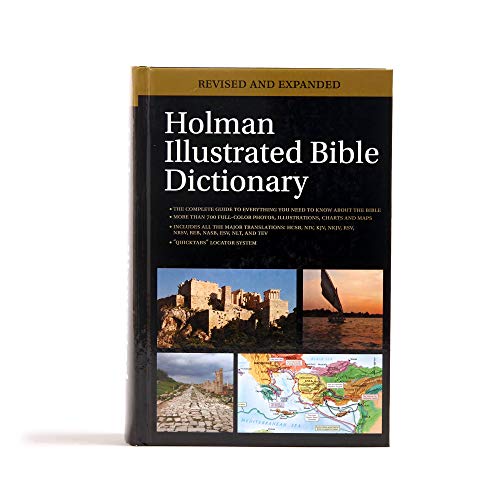
An approachable home reference for looking up the Bible’s people, places, objects, and subjects.
Best for: Beginners who want a definition first and room to explore a topic in more detail.
Highlights
- Concise definitions followed by fuller articles
- Illustrations, maps, reconstructions, and charts
- Revised and expanded English third edition
Watch-outs
- A substantial book to consult at home
- Not a guided daily study or verse-by-verse commentary
- Debated questions need careful reading of the evidence
What does this edition include?
B&H’s product page identifies a 1,800-page reference edited by Chad Brand, Eric Mitchell, and the Holman Reference Editorial Staff. It describes more than 6,500 articles and about 700 photographs, maps, reconstructions, and charts.
The feature I find most promising for a beginner is the entry structure: a brief definition first, followed by more detailed treatment. You can get your bearings before deciding how much background you need.
This review concerns the English revised and expanded edition linked below. Check the ISBN when comparing listings for older versions, other languages, or similarly named Holman reference books.
Is a Bible dictionary the same as a normal dictionary?
A normal English dictionary helps with ordinary word meanings. A Bible dictionary also supplies background on people, places, objects, events, and theological subjects. That is useful when you understand the English sentence but do not know what a name or practice refers to.
I would choose a general Bible dictionary before a specialist word-study dictionary if most of my questions were “Who is this?” and “Where is that?” For readers beginning to investigate Hebrew and Greek vocabulary, the Vine’s review explains a different kind of lookup.
Three beginner lookups to try
Here is an original routine built around a person, a place, and a term. It is not a quotation or a report of testing these exact entries in a physical copy. Use the dictionary’s alphabetic arrangement and cross-references to locate relevant material, and adjust the heading if your wording differs.
| Start with this reading | Investigate | Bring the answer back to the passage |
|---|---|---|
| Exodus 3:1–12 | Moses | Which details belong to this point in his story, and which come later? |
| Luke 10:25–37 | Samaria or Samaritans | What background helps you notice whom Jesus places in the role of neighbor? |
| Leviticus 25:1–7 | Sabbath | How does the passage describe rest for the land, rather than only a weekly routine? |
First read the passage without the reference book. Write one specific question, consult the relevant material, and then reread the passage. Keep your answer short enough to explain to someone else.
For the Luke example, do not let a page of historical background crowd out the conversation between Jesus and the questioner. Ask how the story answers that conversation. The reference helps establish context; the passage tells you what is happening within it.
For the Leviticus example, keep the wording and scope of the passage in view. A broad article on a term may discuss several uses, and they should not all be imported into every occurrence.
How much detail should a beginner read?
I would start with the definition and the part of the article closest to my question. Follow a cross-reference only when it clarifies something you need to understand. You can leave the remaining material for another day.
That approach keeps a reference session from becoming a trail of unrelated facts. One useful answer is often enough to let you continue reading with confidence.
If you are starting from scratch, pair this habit with the beginner Bible-study guide. The dictionary should serve your reading, not become another assignment you feel behind on.
What are its limitations?
A large collection of articles still reflects editorial choices. On debated theological or historical questions, distinguish a definition from an argument. Look at the passages and reasons offered rather than assume the dictionary’s conclusion settles the discussion for every Christian tradition.
Reconstruction drawings can help you picture a setting, but they are interpretations of evidence. Do not present them as photographs of how an ancient building certainly looked.
The publisher lists the book at 5.25 pounds. I would plan a place to consult it at home rather than buy it as an everyday carry-along. I cannot judge its physical readability or handling comfort from specifications alone.
My verdict
I would consider Holman a useful home reference for a beginner who enjoys asking questions about the Bible’s world and wants room to grow. Its definition-first structure gives you a manageable way in. Use it selectively, check the exact edition, and return to Scripture after each lookup.
If book-by-book orientation is your main goal, consider the Halley’s Bible Handbook review instead. You can build a useful reference shelf gradually as your actual questions become clear.