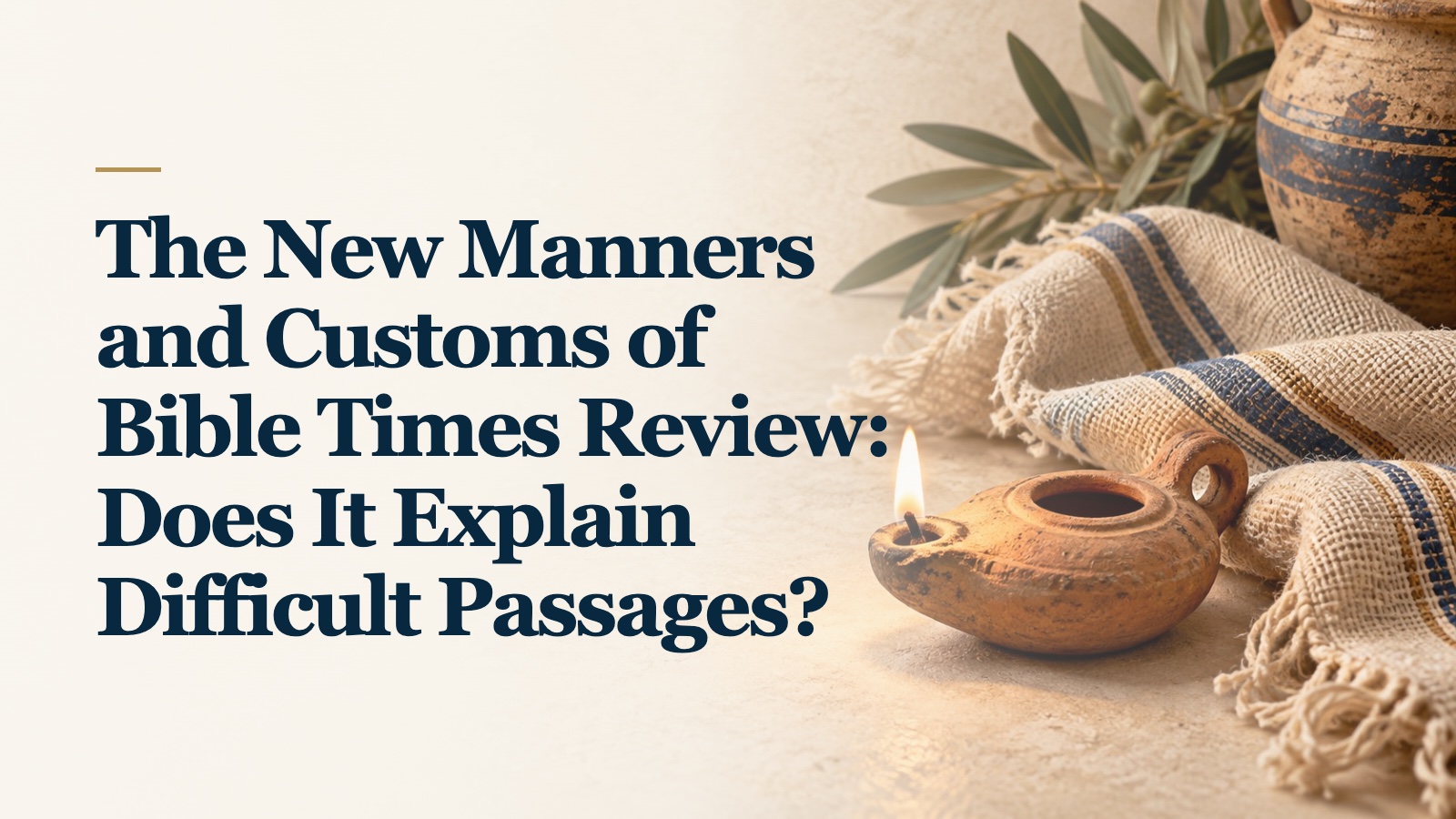
The New Manners and Customs of Bible Times can help when a passage is difficult because its everyday world feels unfamiliar. I would consider it for questions about households, work, clothing, and social customs. I would not expect one background book to settle every difficult interpretation.
It is easy to bring modern assumptions to an ancient passage without noticing. A cultural reference gives us a reason to slow down and ask what the original setting contributes to our reading.
This is a research-based review of Ralph Gower’s hardcover, ISBN 9780802459657. I checked publisher information, rather than examining a physical copy. I am not reporting hands-on testing or a survey of customer reviews.

A useful starting point for investigating the everyday world behind a Bible passage.
Best for: Readers and group leaders with questions about unfamiliar objects, work, and social customs.
Highlights
- Illustrated cultural and historical background
- Scripture and topical indexes
- Photography, maps, diagrams, and charts
Watch-outs
- A companion rather than a verse-by-verse commentary
- Published in 2005, not a continuously updated database
- Check that each explanation fits the passage’s time and setting
What is this book?
Moody Publishers identifies this as a 352-page hardcover published in 2005. Its illustrated format includes photography, artwork, maps, diagrams, and charts. Scripture and topical indexes provide two ways into the material: start with a passage or start with a subject.
Those indexes are the feature I would look at first. A reference book becomes useful when you can get from a question to a relevant section without reading it cover to cover.
What kind of question does it suit?
I would approach this book with concrete questions rather than a general hope that it will make everything clear. “What should I investigate about farming here?” is more productive than “What is the secret meaning of this passage?”
| If you are wondering about… | A useful next step |
|---|---|
| A household object | Identify its role in the passage, then look for background on its ordinary use. |
| Work or farming | Note what the biblical writer actually describes before adding cultural detail. |
| Marriage or family relationships | Check the specific time, place, and situation rather than assuming one universal ancient custom. |
| An unfamiliar garment | Ask whether its function matters to the passage’s argument. |
These are suggested questions for using a customs reference. They are not promises that this edition answers every example you bring to it.
A worked reading approach with Ruth
For a first exercise, read Ruth 2 all the way through. On your own page, separate what the narrative states from what you would like to investigate.
The chapter describes Ruth gathering grain, Boaz speaking with her, and instructions concerning her treatment in the field. Those observations come from Ruth itself. Questions about harvesting practices and provisions for people in need are the next stage of study.
Then read Leviticus 19:9–10 and Deuteronomy 24:19–22 alongside Ruth. Those passages give biblical context for leaving part of the harvest for others. Use the customs book’s indexes to seek relevant farming background, keeping any explanation you find beside the Scripture references rather than replacing them.
Finally, write two sentences: one describing what you learned about the setting, and one describing what Ruth 2 shows through the characters’ actions. If the background note does not help you read the chapter more attentively, you do not need to build your lesson around it.
This is my suggested study method, not a reproduced exercise or an account of using this physical edition.
Where I would be cautious
Historical context is valuable, but an interesting explanation is not automatically the right explanation. Ask whether a claimed practice fits the particular period and community. A custom documented in one place or century should not be applied to every biblical story without support.
Publication age also matters when the question involves newer archaeological findings. This is an established reference, not a continuously updated research database. For a disputed claim that will carry the weight of a sermon or lesson, consult another qualified source and explain any uncertainty.
I would avoid treating cultural background as a hidden key available only to specialists. Begin with the passage’s words, literary setting, and related Scripture. Let historical information clarify those observations.
Who should buy it?
A good fit if you
- Regularly pause over unfamiliar objects and practices.
- Prepare Bible discussions and want to investigate the setting responsibly.
- Prefer an illustrated reference to a dense specialist monograph.
Look elsewhere if you
- Need a first Bible rather than a companion resource.
- Want a commentary explaining every verse in one biblical book.
- Need current academic treatment of a particular historical debate.
For basic orientation, the beginner Bible-study guide can help you decide which kind of resource to start with. For routes and book outlines, consider Nelson’s Maps and Charts. For a focused visual treatment of the tabernacle, see the Rose Guide to the Tabernacle review.
My verdict
I would recommend considering Gower’s book when cultural questions repeatedly interrupt your reading. Its value is in helping you investigate the world behind a passage. Keep your expectations specific, use the indexes, and bring what you learn back to the biblical text. That is a healthier goal than expecting any reference book to remove every difficulty.