Nelson’s Complete Book of Bible Maps and Charts is worth considering if you want help seeing how a Bible book fits together and where its events happen. I would put it on the shortlist for a small-group leader or a reader who keeps turning to the maps in the back of a Bible and wishing for more context.
I would be less inclined to recommend it as your first purchase if your main question is what an individual verse means. A good study Bible may meet that need more directly.
This is a research-based review, not a hands-on assessment. I checked the publisher’s description of the third edition, print ISBN 9781418541712. I have not tested the binding, print readability, or usefulness of every chart.
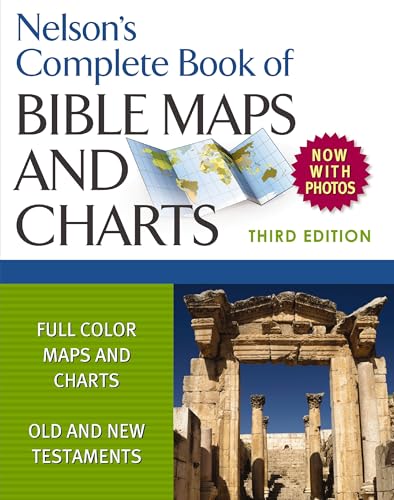
A visual reference for following Bible events, places, and book outlines.
Best for: Bible readers and small-group leaders who want more context than a few back-of-Bible maps provide.
Highlights
- Maps, charts, diagrams, and book introductions
- A broad overview of the Old and New Testaments
- Third-edition print reference
Watch-outs
- An overview rather than verse-by-verse commentary
- Check map-label readability in a print sample
- Detailed historical questions may need fuller sources
What edition are you buying?
The publisher’s listing identifies a 480-page softcover third edition from Thomas Nelson. It combines Bible-book introductions, maps, charts, diagrams, and historical background. That combination matters: this is a visual survey and reference companion, rather than simply a collection of maps.
Check the edition and format on the listing before ordering. A digital edition and a secondhand print copy may offer different reading experiences. My recommendation here concerns the third-edition print book linked below.
Who will get the most from it?
A good fit
- Readers who want an overview before beginning a Bible book.
- Small-group leaders planning a short introduction to a passage.
- Visual learners who organize information through maps and outlines.
Think twice
- You primarily need verse-by-verse explanations.
- You want detailed discussion of competing archaeological conclusions.
- You already own a reference book that meets these same needs.
The question I would ask before buying is simple: where does my Bible reading regularly get stuck? If it is the sequence of events, the relationship between books, or the place names, this kind of companion makes sense. If it is understanding the argument of a difficult paragraph, start with closer reading and appropriate commentary.
A practical way to use it with Acts
Here is an original study routine, not a claim that the book contains this exact exercise. Read Acts 13:1–14:28 in your Bible, then make a short list of the places named. Use the reference book’s contents and index to locate the relevant background and map material.
Keep three questions beside you:
| Question | What to record |
|---|---|
| Where does this part of the journey begin and end? | The locations named in the passage. |
| What happens in each place? | A brief note drawn from Acts itself. |
| What does the map help me notice? | A geographical connection, kept separate from the passage’s main message. |
Return to the biblical text after looking at the map. Ask what the account emphasizes about the message, the hearers, and the missionaries. Geography should help you follow the narrative; it should not become a substitute for reading it.
For a group lesson, choose one useful visual and one discussion question. Showing every interesting detail can make a short introduction harder to follow.
What are its limits?
An overview necessarily leaves things out. A chart can organize an argument, but it cannot explain every interpretive decision behind that organization. Treat its headings as a guide to investigate, not as the only possible way to outline a biblical book.
Likewise, a historical map is a reconstruction. When a lesson depends on an exact boundary, route, or disputed identification, check a more detailed source before presenting it as settled fact. This is a reading habit I recommend for any Bible atlas or chart book.
I would also check a print sample if small labels are a concern. Page count alone does not tell us whether a map is comfortable for your eyes, and I cannot judge that from publisher specifications.
Do you need this and a study Bible?
Not necessarily. Start with what you own. Read a book introduction, consult the existing maps, and decide what is still missing. If that answers your questions, there is no need to buy another reference immediately.
If you want a broad collection of topical visuals as well, see my Rose Book of Bible Charts, Maps and Time Lines review. If unfamiliar daily life is the real obstacle, the Manners and Customs review addresses a different kind of background help.
My verdict
I would choose Nelson’s for Bible-book orientation and visual preparation, especially when a reader wants more structure than a few back-of-Bible maps provide. I would pair it with Scripture and use it selectively. Buy it for the questions it can help organize, with realistic expectations about how much explanation a visual reference can supply.