For an adult starting to read the Bible, I would choose a full-text edition in understandable English, with print you can read comfortably. After that, decide whether you want simple guidance for a new Christian, answers to questions, or more extensive application notes. Those are different needs, and one Bible does not have to do everything.
My shortlist is the New Believer’s Bible NLT for first steps in Christian faith, the NIV Quest Study Bible for readers who keep asking questions, and the NLT Life Application Study Bible for readers who want more explanation alongside the text. A plain Bible in your church’s translation is also a sound choice.
This is a research-based buying guide. I checked publisher descriptions and the specific editions below, rather than testing physical copies. My recommendations concern the advertised reading helps, not measured paper quality or binding life.
Which kind of help do you want?
| Your starting point | My suggested direction | Main trade-off |
|---|---|---|
| I am new to Christian faith | New Believer's Bible NLT | Guidance reflects its Christian editorial perspective |
| I want answers beside difficult passages | NIV Quest Study Bible | Questions and notes add visual detail to the page |
| I want help connecting reading with daily life | NLT Life Application Study Bible | The large-print edition is a substantial volume |
| I want to follow a church group | A full-text Bible in the group's translation | You may need a separate source for explanations |
1. New Believer’s Bible NLT: for first steps in faith
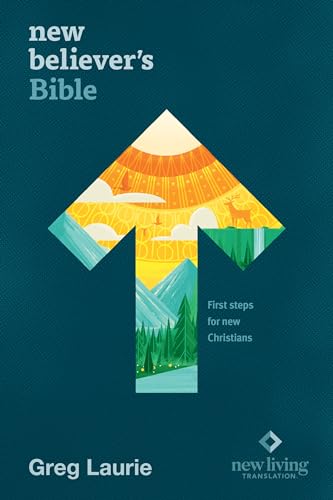
New Believer's Bible NLT (Hardcover): First Steps for New Christians
Highlights
- Full New Living Translation text
- Notes organized around Christian beliefs and first steps
- A focused alternative to a large reference library
Watch-outs
- Its notes are Christian instruction, not a neutral survey of religions
- Check the type sample before choosing this hardcover
Best for: an adult asking how to begin reading and living as a Christian.
Skip it if: you want extensive historical or language-reference material.
Tyndale’s New Believer’s Bible description identifies the hardcover as ISBN 9781496434043. Its Cornerstones and First Steps features explain foundational beliefs and practical next steps. That focus is the reason I would consider it for a new Christian.
It is also useful to distinguish a new Christian from a new Bible reader. Someone studying Christianity from outside the faith may prefer a plain full-text edition and conversations with a knowledgeable reader. The notes here intentionally teach Christian belief.
2. NIV Quest Study Bible: for readers with questions

NIV, Quest Study Bible, Hardcover, Blue, Comfort Print: The Only Q and A Study Bible
Highlights
- Full New International Version text
- Question-and-answer notes beside the reading
- Book introductions and supporting reference material
Watch-outs
- A study note is an interpretation, not another verse
- Check both Scripture and note sizes in the sample
Best for: a reader who wants help understanding unfamiliar passages.
Skip it if: a page with many notes makes it harder to concentrate.
The blue Comfort Print hardcover is ISBN 9780310450818. Its question-led format gives you a practical place to look when you wonder who a person is or why something happened. The publisher’s catalog describes this edition’s Q&A approach.
I would read a paragraph of Scripture first, then consult a relevant note. Reading every note before continuing can turn a short passage into an intimidating assignment. It is fine to leave a question open and return to it later.
3. NLT Life Application Study Bible: for context and application

NLT Life Application Study Bible, Third Edition, Large Print (LeatherLike, Teal Blue, Red Letter)
Highlights
- NLT text with explanatory and application material
- Large-print option for readers who need more visible text
- A resource to keep using beyond the first reading plan
Watch-outs
- More content means a larger book
- The notes may feel like more than you need at first
Best for: someone who wants explanations and practical reflection in one volume.
Skip it if: you need a light Bible to carry every day.
The linked third-edition large-print LeatherLike teal-blue Bible is ISBN 9781496439352. Tyndale’s edition page is the place to check its current specifications and interior preview. Do not assume that a similarly colored KJV or NKJV edition contains the NLT text.
If you want to compare this style with a more reference-heavy option, my ESV Study Bible vs. Life Application comparison explains the different purposes.
How should you choose a translation?
Start with your reading setting. If a small group uses the NIV, following the same wording may make discussion easier. If you are reading independently, compare a short Gospel passage in several translations and choose wording you can follow without constantly stopping.
NLT often expresses a thought in flowing contemporary English. NIV balances close attention to the original wording with readable English phrasing. CSB and ESV offer other approaches that many churches use. None of these labels tells you which physical edition has larger type or more helpful notes. Translation and book design are separate decisions.
If you belong to a Catholic or Orthodox church, ask about the biblical canon and an appropriate edition before buying one of these Protestant editions. A recommendation should fit your church context as well as your reading level.
Check these details before ordering
- Full text or selected stories? A storybook adaptation is useful for a different purpose. The children’s title The Beginner’s Bible is not a complete Bible for adults.
- Scripture size and note size. Large Scripture text does not guarantee large footnotes. Examine a sample at roughly the printed page size.
- Reading at home or carrying it? Extensive notes and large print add bulk. A simpler edition may suit a commute or church bag.
- Aids you will use. Book introductions, maps, and a readable contents page may help more than a long list of features.
You do not need a complete supply kit to begin. A Bible, a bookmark, and a notebook are enough. My beginner Bible-study guide covers study resources once you know what help you need.
An uncomplicated first week
Try reading the first chapter of Mark across several sittings. Notice who is speaking, what happens, and what you want to ask. Write one question and one observation after each sitting. This is a suggested practice, not a requirement to finish a fixed number of verses.
My advice is to choose a Bible you can comfortably open and read today. Helpful notes should support that habit. They do not have to turn your first week into a course.