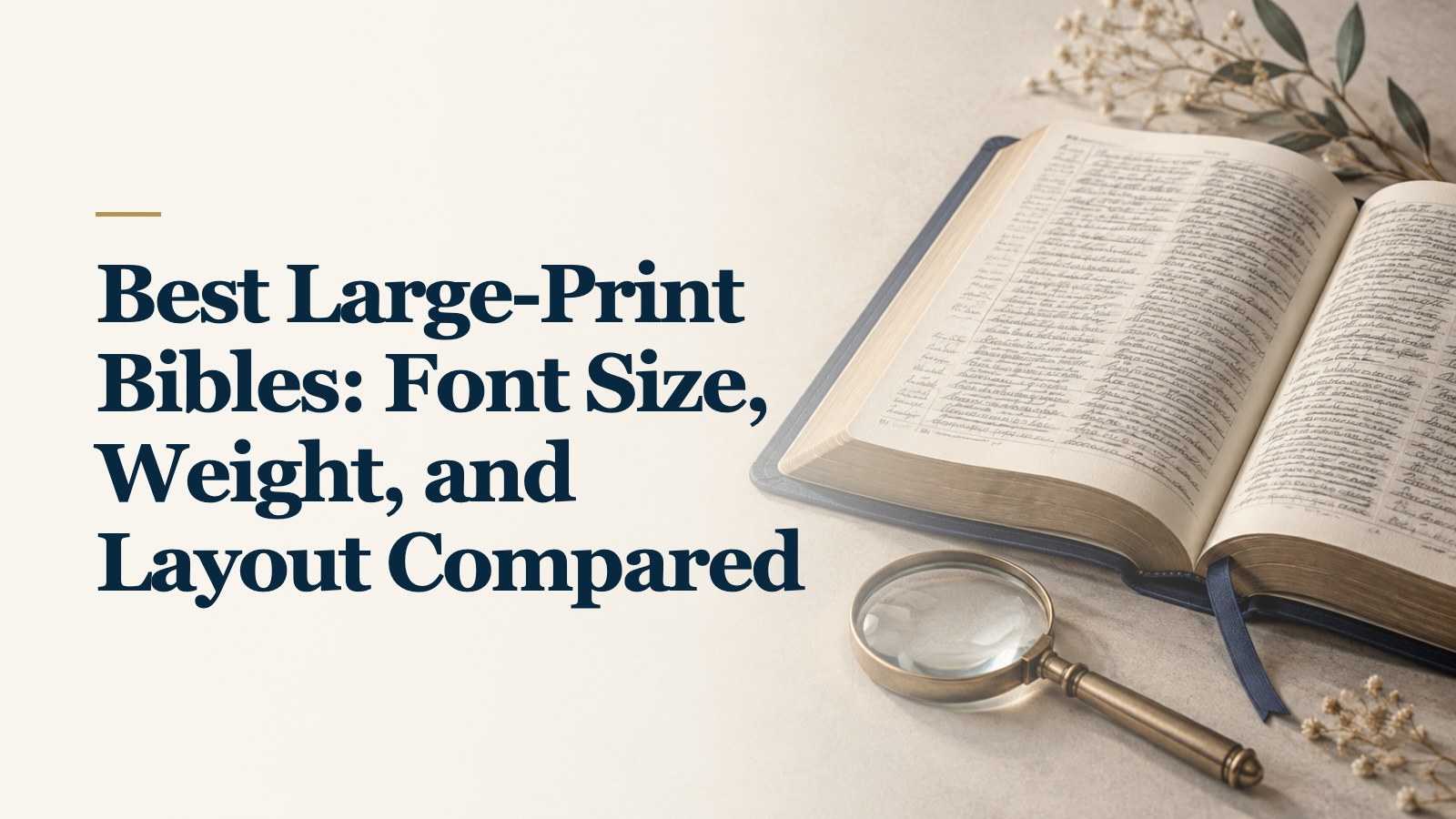
I would choose a large-print Bible by the exact type sample, page layout, and carrying size rather than the words large print on the cover. For a portable reference edition, start by comparing the ESV Large Print Thinline Reference Bible. For handwritten notes, look at the ESV or CSB journaling options. For fuller study help, consider the NLT Life Application edition.
These are different kinds of Bible. Bigger print, more notes, and more writing space all compete for page area. Decide which matters most before choosing a binding.
This guide compares advertised specifications for exact editions. I have not tested their physical reading comfort or measured weights myself. A missing weight below means unverified, not light.
Compare exact editions
| Edition | Advertised Scripture size | Layout and size | Weight evidence |
|---|---|---|---|
| ESV Thinline Reference, 9781433581670 | 10.5 point | Double column; 6.125 × 9.125 × 1.1875 inches | Publisher: 29.14 ounces |
| ESV Journaling Large Print, 9781433568732 | 9.5 point | Single column, two-inch ruled margins; 6.5 × 9.25-inch listed size | Not verified here |
| CSB Notetaking Large Print, 9781087785516 | 9.5 point | Single column, two-inch margins; catalog page size 7.25 × 9.38 inches | Not verified here |
| NLT Life Application Large Print, 9781496439352 | 10.75 point | Current publisher trim 6.5 × 9.187 inches; extensive study material | Not verified here |
The figures come from Crossway’s reference edition, Crossway’s journaling edition, Holman’s catalog, and Tyndale’s NLT edition. Page size, trim size, and outside cover dimensions are not interchangeable measurements.
1. ESV Large Print Thinline Reference Bible

ESV Large Print Thinline Reference Bible (TruTone, Brown/Walnut, Timeless Design): Holy Bible, English Standard Version
The brown/walnut TruTone reference edition has 10.5-point text, cross-references, and a double-column layout. Crossway lists a thickness just over one inch and a weight of 29.14 ounces. That makes it a useful comparison point when extensive study notes are not your priority.
Watch for: thinline is a format label, not a promise of pocket size. Cross-references and other secondary material may be smaller than the Scripture text. Check a real-size interior sample if small supporting text is difficult for you.
2. ESV Single Column Journaling Bible, Large Print

ESV Single Column Journaling Bible, Large Print (TruTone, Burgundy/Red, Timeless Design): Holy Bible, English Standard Version
This burgundy/red edition pairs 9.5-point text with ruled margins. The useful distinction is the single-column writing layout. Although the name says large print, its stated Scripture size is smaller than that of the reference edition above.
Watch for: choose it because you want to write beside the text. If writing space is unnecessary, you may prefer to spend that page area on larger type or a more compact book.
3. CSB Notetaking Bible, Large Print

CSB Notetaking Bible, Large Print Edition, Camel LeatherTouch, Black Letter, Wide Margins, Journaling Space, Single-Column, Reading Plan, Easy-to-Read Bible Serif Type
The camel LeatherTouch edition uses 9.5-point single-column text and two-inch lined margins. Holman’s catalog advertises a Smyth-sewn lay-flat binding. It is a practical candidate if the CSB is the translation you want and you need a margin for regular notes.
Watch for: its broad page needs room when open. Check outside dimensions for carrying or a case; a catalog page measurement is not a case-sizing guarantee.
4. NLT Life Application Study Bible, Third Edition, Large Print

NLT Life Application Study Bible, Third Edition, Large Print (LeatherLike, Teal Blue, Red Letter)
The teal-blue LeatherLike edition is identified by ISBN 9781496439352. Tyndale’s current page lists 10.75-point text and 3,264 pages. It offers a different purpose from a plain reference Bible: substantial explanatory and application material alongside the biblical text.
Watch for: larger Scripture type does not tell you the size of every study note. Preview both. The publisher’s current specifications and older seller listings may differ, so match the actual printing and ISBN before relying on page count or layout details.
How to compare a type sample
Print a publisher’s sample at actual size if available, without shrinking it to fit. Read an ordinary paragraph under the light you normally use. Look at the spaces between letters and lines, contrast, column width, and how much reverse-page text shows through.
If you use a screen sample, remember that zoom changes the apparent size. A full page filling a large monitor tells you little about the printed book. I would also compare a psalm and a page with notes, since the layout can vary by literary form.
Large print or giant print?
Those labels are not a single universal point-size standard. A 9.5-point journaling Bible and a 10.75-point study Bible can both be sold as large print. Look for the actual size and sample, and compare a giant-print option when these are still too small for comfortable reading.
I would also consider how you read: a Bible resting on a table is a different carrying decision from one held through a service. If you want help choosing a translation first, see the beginner Bible guide. If margin space is the priority, the journaling comparison covers more options.
My advice is to settle on readable text first, then choose the extra features you will use. A longer feature list cannot compensate for print that is uncomfortable to read.