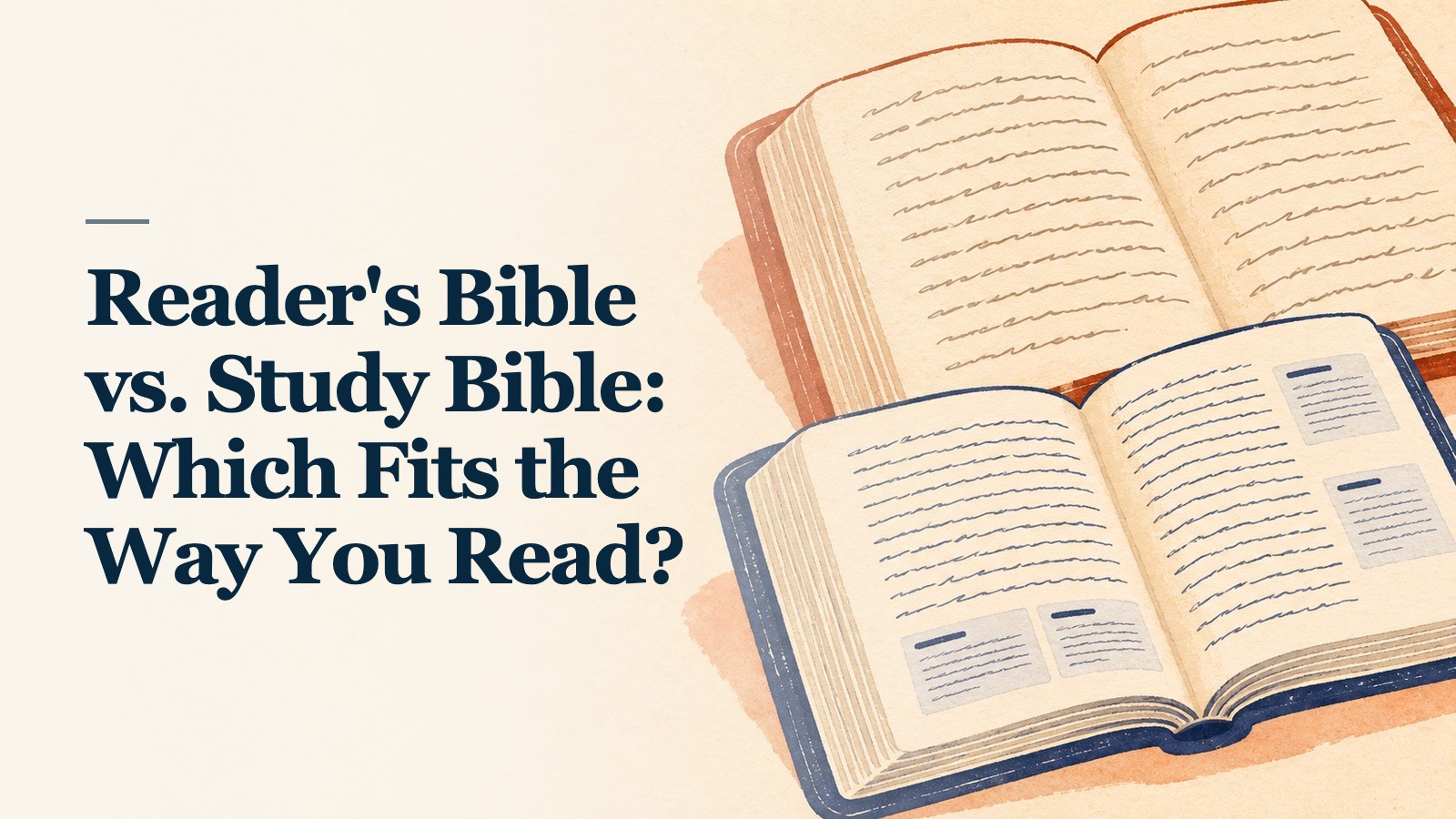
A reader’s Bible emphasizes continuous reading with fewer visual interruptions. A study Bible adds explanatory notes, references, introductions, and other tools for closer investigation. Choose according to the reading task you want help with. Neither format makes the biblical text more authoritative or the reader more spiritual.
My first question would be simple: do you keep losing the flow of a passage, or do you keep stopping because you need an explanation? The first problem points toward a reader’s format. The second points toward accessible study tools.
Reader’s Bible vs. study Bible at a glance
| Feature | Reader's Bible | Study Bible |
|---|---|---|
| Main purpose | Reading extended passages with fewer interruptions | Exploring meaning, background, and connections |
| Page layout | Often generous paragraphs and fewer supplementary elements | Scripture alongside or above notes and references |
| Verse numbers | May be omitted or retained, depending on edition | Normally available for detailed navigation |
| Commentary | Usually little or no running commentary | A major part of the edition's purpose |
| Finding a verse quickly | Depends on retained numbering and navigation aids | Usually straightforward |
| Reading aloud | A clean paragraph layout may help maintain flow | Numbering helps a group find the passage |
| Main caution | Check whether it is a full Bible or selected books | Distinguish Scripture from editorial interpretation |
These descriptions are tendencies. Always inspect the exact edition instead of treating the format name as a specification.
What is a reader’s Bible?
A reader’s Bible presents Scripture in a layout intended for sustained reading. It may reduce headings, reference markers, footnotes, or chapter and verse numbers. That design encourages attention to paragraphs, stories, poems, and arguments instead of treating every numbered verse as a separate saying.
Crossway’s guide to its reader’s editions describes several approaches, including a one-volume Bible, a six-volume set, and selected-book editions. That variety matters. A volume called Reader’s Gospels is not the same purchase as a full Bible.
A reader’s format also does not mean a paraphrase. Translation and page design are different decisions. Two editions may use the same translation while arranging it very differently. Check the translation name and the edition’s contents separately.
Do all reader’s Bibles remove verse numbers?
No. Some do, and some retain them. Crossway’s one-volume ESV Reader’s Bible described in its guide removes verse numbers and uses page-top verse ranges for orientation. The original six-volume approach also removes chapter numbers.
However, Crossway separately describes an ESV Reader’s Bible, Six-Volume Set: With Chapter and Verse Numbers. It retains those numbers while reducing other interruptions. Therefore, “reader’s Bible” does not universally mean “Bible without verse numbers.”
For a reading plan, check whether it assigns whole books, chapters, or short verse ranges. A numbered reader’s edition may fit a verse-based plan more easily. A less numbered edition can still work, but you may want another Bible or an app for precise navigation.
Our six-volume ESV Reader’s Bible review discusses that product family. Confirm the exact numbered or unnumbered version before buying; do not assume every similarly named set has identical features.
What does a study Bible add?
A study Bible puts editorial help near the Scripture text. Its notes may explain a historical custom, show the structure of an argument, discuss a difficult phrase, or suggest ways to apply a passage. Book introductions, maps, charts, and cross-references support that work.
The Crossway study-editions guide illustrates how editions differ in audience and editorial emphasis. A student edition and a comprehensive study edition need not provide the same depth or physical layout.
The extra material is useful, but it is commentary. Read the biblical passage first, then evaluate how the note explains it. Study Bibles also have theological perspectives; read the introduction and contributor information when that affects your choice.
What changes when you read the same passage?
Try Luke 10:25-37 in the edition you already own. The following is an original reading exercise, not a reproduction of commercial page layouts or a report of physical testing.
In a reader’s format, read the complete exchange and story without stopping. Watch how the initial question leads to another question and then to a concrete example of mercy. Summarize the movement of the passage in one sentence. The format’s value is the opportunity to follow that movement with fewer nearby distractions.
In a study format, read the same passage before consulting the tools. Then ask one question, such as why the identity of the Samaritan matters in the narrative. Consult the relevant note, compare the references to Deuteronomy 6:5 and Leviticus 19:18, and return to Luke to check what the explanation adds.
The passage has not changed. Your task has changed: first follow the whole unit, then investigate a detail. You can do both tasks with either format, but the page design may make one easier to maintain.
Which format fits devotional reading, church, or study?
| Situation | A useful starting choice | Reason to check the alternative |
|---|---|---|
| Reading a Gospel in long sections | Reader's edition | A study note can help with a difficult background question |
| Preparing a small-group discussion | Study Bible | A clean first read can keep you from starting with commentary |
| Following frequent verse references in a sermon | Numbered study or reference edition | A numbered reader's edition may also work |
| Reading a letter in one sitting | Reader's edition | An introduction and outline may clarify the larger argument |
| Beginning Bible reading | A readable edition you can navigate | Add notes if unanswered questions are stopping you |
| Carrying one volume everywhere | Compare actual dimensions and weight | Neither format name guarantees portability |
I would avoid buying a large set solely because it looks beautiful if you mainly need one Bible for a weekly group. Equally, I would not insist on a heavily annotated page if your goal is to read several chapters without repeatedly looking down at the notes.
Is a reader’s Bible a good choice for beginners?
It can be, especially for someone who wants to encounter a whole story or letter without navigating many symbols. Yet a new reader may also appreciate book introductions, verse numbers, and explanations of unfamiliar customs.
A practical starting point is a short complete book or a coherent Gospel section. If you feel lost because of missing navigation, try a numbered edition or keep an app nearby. If the notes pull your attention away every few lines, read the passage once before looking at them.
You do not have to decide your permanent format before beginning. Our Bibles for beginners guide addresses translation and feature choices separately.
Do you need to own both?
No. You can use one Bible in two stages: read first, investigate second. Cover the note area with a plain sheet of paper if that helps you attend to the paragraph. Use a bookmark or notebook to collect questions rather than interrupting every sentence.
If you already own both formats, give each a defined job. You might read a chapter or a whole letter in the reader’s edition, then use the study edition for the questions you wrote down. Keep the second stage tied to actual questions instead of treating every note as compulsory reading.
An app can provide another layout without requiring another printed book, though available tools and translation permissions vary. See our Bible study apps guide for the difference between free Bible readers and expandable study libraries.
What should you check before ordering?
Use this short checklist:
- Contents: Full Bible, one testament, selected books, or a multi-volume set?
- Translation: Is it the translation you intend to read?
- Numbering: Which chapter numbers, verse numbers, and page-top references remain?
- Supplementary material: Are there notes, introductions, maps, or translation footnotes?
- Readability: What do a prose page and a poetry page look like in the exact edition?
- Handling: What are the dimensions and weight of the individual volume you will actually hold?
- Identity: Does the ISBN match the numbered or unnumbered version you want?
If you choose study tools, our guide to using a study Bible walks through the page. If you are ready to compare particular products, use the study Bible roundup. Start with the reading job, then select the binding and extras.
Research note: publisher edition descriptions were checked November 6, 2026. Recommendations are based on documented format differences and original reading exercises, without claiming hands-on comparison of these editions.