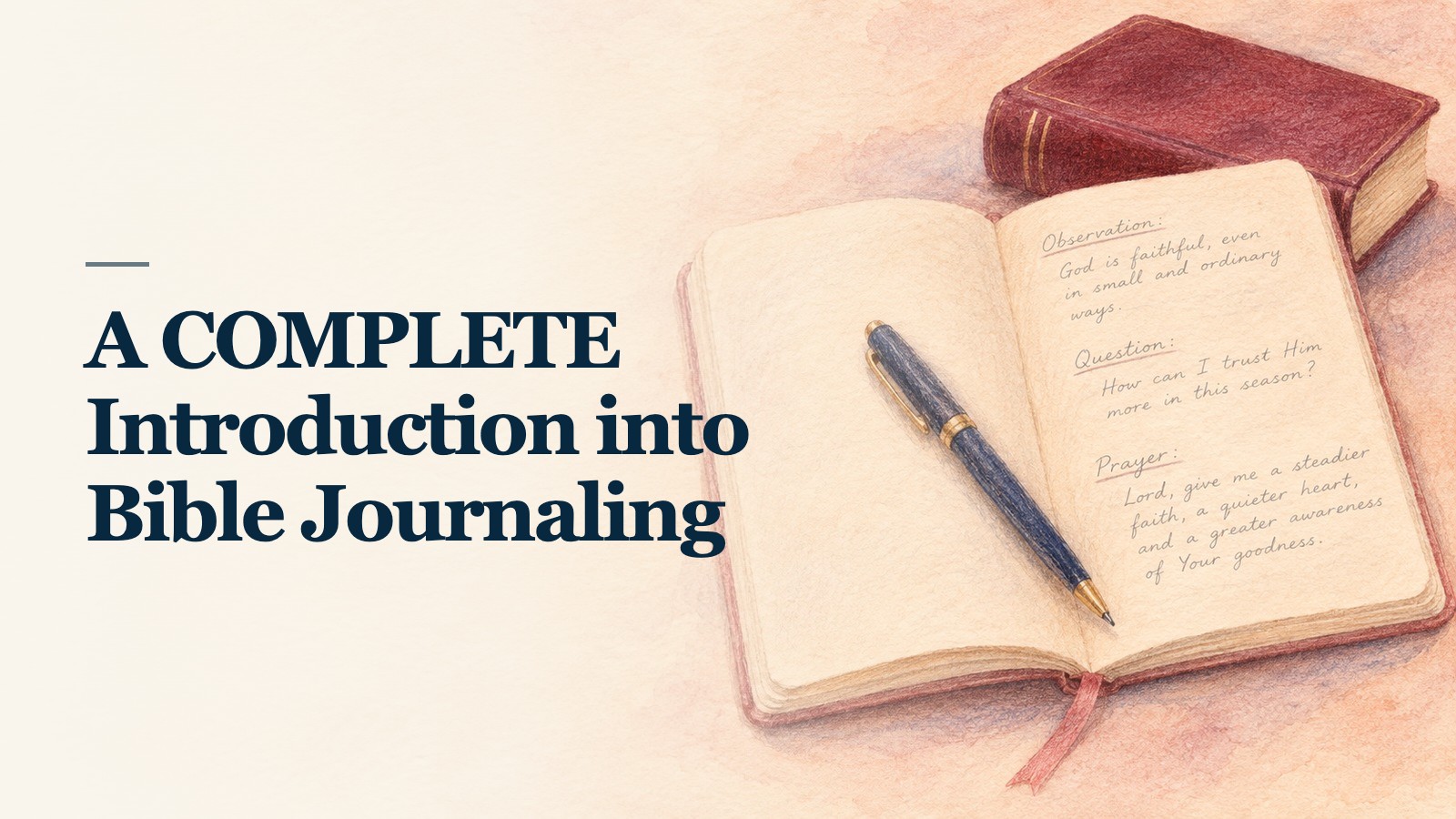
Bible journaling means recording observations, questions, prayers, and responses as you read Scripture. You can begin with an ordinary Bible, a notebook, and a pen. Drawing, lettering, stickers, and a special journaling Bible are optional.
I would rather help you finish one thoughtful entry than give you a shopping list that delays your first page. A short note that stays close to the passage is useful even when your handwriting is untidy and your only decoration is the date.
What is Bible journaling, and what is it for?
Bible journaling is a way to slow down and put a reading response into words. That might mean a few words in a margin, a paragraph in a separate notebook, a question to discuss with a group, or a written prayer.
Keep three things distinct: what the biblical passage says, your interpretation of it, and your personal response. A journal can hold all three, but writing down an impression does not automatically make it a message from God. Check your conclusions against the passage in context and be willing to revise them.
This article offers original teaching examples rather than claiming a particular journaling method is scientifically proven to improve memory or treat a health condition. The aim is a thoughtful practice of reading and responding to Scripture.
What supplies do you actually need?
| Essential starting item | What it does | Simple option |
|---|---|---|
| A Bible | Supplies the passage you are reading | Use the edition you already own |
| A place to write | Keeps observations and questions together | A spare notebook or a text document |
| A writing tool | Records the response | An ordinary pen in a notebook |
| A reference and date | Helps you find the entry again | Write the book, chapter, verses, and date at the top |
A journaling Bible generally provides room for notes, but layouts vary. Check the sample: wide blank margins, ruled margins, illustrated pages, and interleaved blank pages are different arrangements. None is required for starting.
If you want to compare formats later, our journaling Bible guide is a useful next step. If you prefer keeping the Bible page clear, use a notebook beside any readable Bible.
How do you start Bible journaling without drawing?
Use this five-part entry:
- Reference: Record the passage you read.
- Observation: Write what happens or what the author says.
- Question: Identify something you need to understand.
- Response: Choose a concrete application that fits the passage.
- Prayer: Turn the response into a short, honest prayer.
Read a complete paragraph or episode before writing. Read nearby paragraphs when the meaning depends on them. Do not assume that every biblical passage is a parable: letters, poetry, wisdom, law, prophecy, and narrative require attention to their own forms.
You may copy a short quotation with its translation identified, but you can also summarize in your own words. The examples below paraphrase biblical passages instead of reproducing a commercial Bible translation.
Example 1: A finished margin note
Passage: James 1:19-27. Read the whole section before focusing on a single instruction. Notice its connection between hearing and doing, including speech and practical care.
Here is an original example of a compact margin entry:
James 1:19-27. Hearing should lead to action. Today: let my coworker finish speaking before I answer. Question: how does the mirror illustration explain self-deception?
That entry fits three useful functions into a small space: a summary, a specific response, and a question worth returning to. It does not try to turn the entire passage into a slogan about communication.
If your Bible’s margin is narrow, put a small reference to a notebook page beside the passage instead. Avoid squeezing commentary over the biblical text. A clean, readable Bible page is more useful than fitting every thought into the margin.
Example 2: A finished notebook entry
Passage: Luke 10:25-37. This section includes a question, a response, and the story of a wounded traveler. Read the exchange as a unit before deciding how to respond.
Reference: Luke 10:25-37.
What I observe: The discussion about loving God and neighbor leads to a question about the neighbor. The story contrasts people who pass by with a Samaritan who gives practical help. Jesus directs attention toward showing mercy.
What I need to understand: Why would the Samaritan’s identity matter to the original audience? I will consult a study note rather than inventing background details.
My response: I have been postponing a promised call to someone who needs support. I can call tomorrow and ask what practical help would be useful, without assuming I already know the answer.
Prayer: Lord, help me notice needs and follow through with appropriate care. Show me where I am using questions as an excuse to avoid kindness.
Follow-up: Return to this entry in a week and record whether I made the call. If I did not, name the obstacle honestly rather than writing a more impressive plan.
This example distinguishes observation from application. The phone call is an illustrative response, not a command supplied word for word by the passage. That distinction leaves room for a different appropriate response in another reader’s circumstances.
Example 3: A finished prayer response
Passage: Psalm 13. Read the whole psalm and notice its movement through distress, petition, and trust. A prayer response does not require pretending that the distress has disappeared.
Here is an original model prayer:
Lord, I find it hard to wait when a problem remains unresolved. Help me speak honestly to you and remember your care. Give me the courage to ask for help from people I trust. I do not know how this situation will turn out, but I want to keep bringing it before you.
Below it, add one line: “Question for later: how does the ending relate to the opening complaint?” You can hold a question and a prayer on the same page.
A written prayer is personal. You do not owe social media a photograph of it. Keep sensitive details about other people private, and ask permission before sharing a story that identifies them.
An original notebook layout you can copy
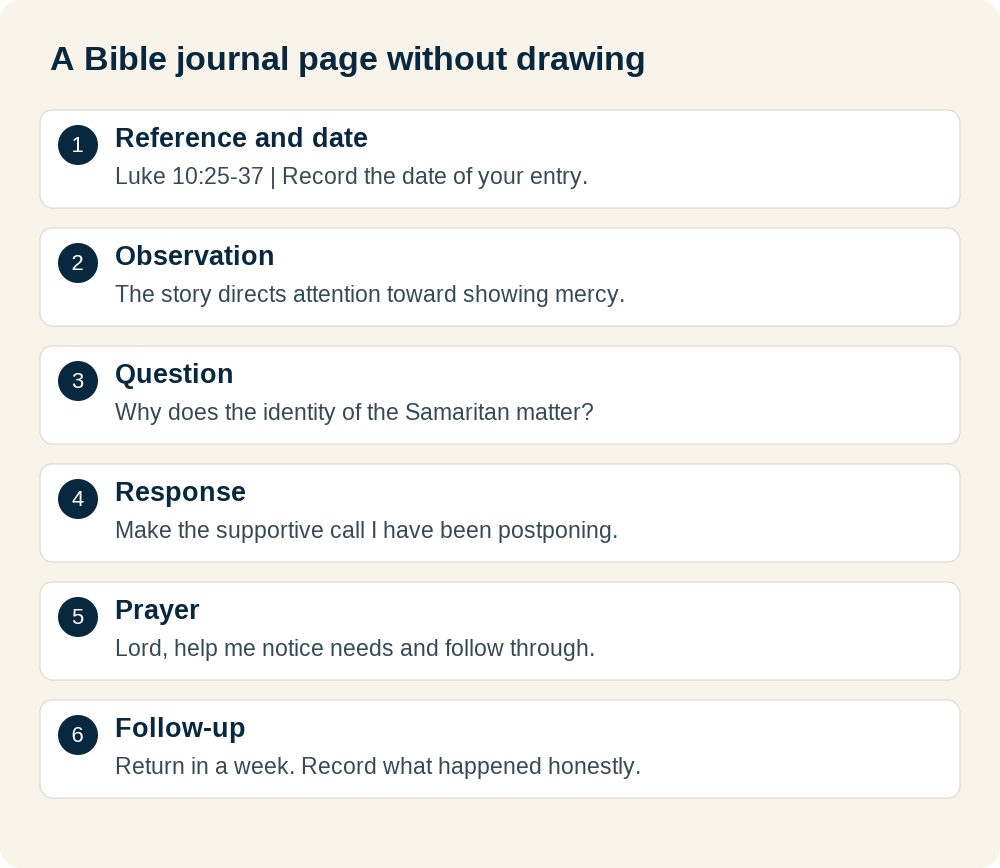
This is an explanatory illustration. Copy the labels into an ordinary notebook; no printable file or special journal is needed.
If a full page feels too much, use three lines: “I noticed,” “I need to understand,” and “I will respond.” Start small enough that you can pay attention to the passage rather than to filling a template.
How do you keep application faithful to the passage?
Before treating an entry as guidance, ask:
- Have I read what comes before and after this verse?
- Who is being addressed in the passage?
- Am I distinguishing a description of an event from an instruction?
- Have I turned a particular promise into a guarantee the passage does not make?
- Does my proposed response fit the passage’s main concern?
- What would make me reconsider my interpretation?
For example, a story that records someone doing something does not automatically instruct every reader to repeat the action. A proverb calls for wisdom in application; it should not be treated as a mechanical guarantee for every circumstance.
A study Bible can help answer a background question, but its notes are editorial interpretation. Our study Bible tutorial explains how to use notes and cross-references while keeping Scripture central.
Can you write or highlight directly in a Bible?
That is a personal choice. If you prefer to preserve an unmarked page, use a separate notebook. If you write in the Bible, consider paper thickness, available margin space, and whether you can still read the passage comfortably.
No pen or highlighter is guaranteed to behave identically on every Bible paper. Test lightly on a suitable inconspicuous page, allow the ink to dry, and inspect the reverse before using it throughout the book. Pressing hard can damage thin paper even when the ink itself does not bleed.
Water-based art materials, adhesives, and heavy decoration can affect the paper or add bulk. Begin with small, restrained marks rather than assuming an art-supply technique is safe for an unfamiliar edition. Our Bible journaling pens guide discusses choices without replacing a test on your own paper.
If you want a simple color key, see the Bible highlighter color-code guide and highlighter roundup. Choose only as many categories as you can remember. Colors should help you follow the passage, not become another assignment.
A manageable first week
| Session | Read | Small writing task |
|---|---|---|
| First | James 1:19-27 | Write one observation and one question |
| Second | Return to James 1:19-27 | Add one specific response and prayer |
| Third | Luke 10:25-37 | Separate the story's details from your application |
| Fourth | Return to Luke 10:25-37 | Check one background question with a trusted resource |
| Fifth | Psalm 13 | Write an honest prayer and keep an unresolved question |
| Sixth | Reread one earlier passage | Correct or deepen an entry |
| Seventh | Review your entries | Name one lesson, one open question, and a next passage |
This is an optional practice sequence, not a promise that seven entries produce a particular spiritual outcome. If you miss a session, resume with the passage you were reading. There is no need to manufacture several entries to repair a streak.
What should you do when the page stays blank?
Write a factual sentence first: “This passage contains a conversation,” “The writer repeats this idea,” or “I do not understand the connection between these two paragraphs.” Then reread with that observation in mind.
You can also write a question instead of a conclusion. “What does this word refer back to?” is a useful entry when it leads you to the surrounding text. You are learning to attend carefully, not auditioning to write a devotional book.
For your first entry, use the notebook and Bible already within reach. Read one coherent passage, write three honest lines, and return tomorrow. The practice can grow after the habit has somewhere simple to begin.
Updated November 6, 2026 with original no-drawing examples and corrected guidance about context, personal impressions, and supplies. Reading references can be checked in your preferred translation; the worked entries are original paraphrases and responses.